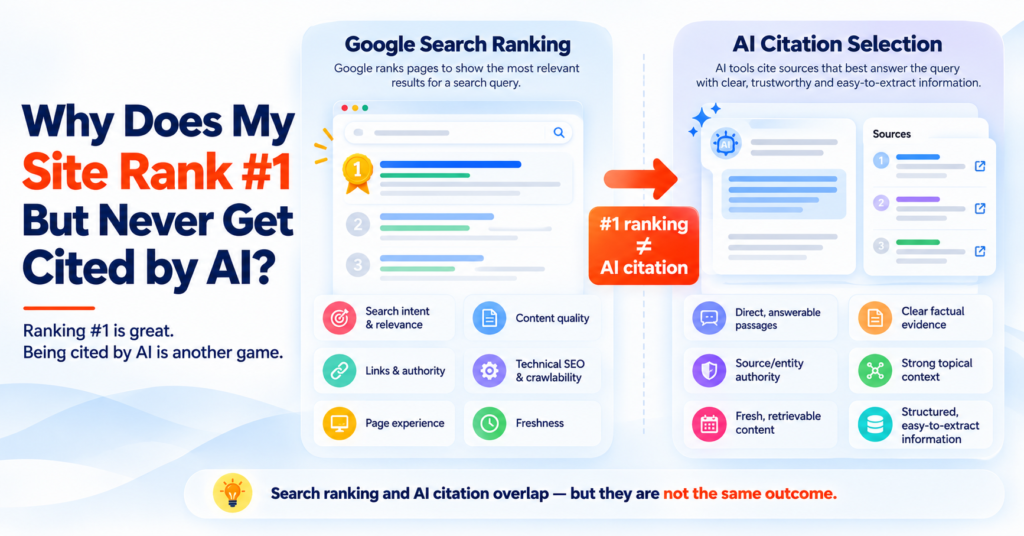
Why Does My Site Rank #1 But Never Get Cited by AI?
ou did everything right. Your page sits at position one on Google. The keyword research was solid, the backlinks are real, the content is genuinely good. And yet when you ask ChatGPT or Perplexity the exact question your page answers, your brand never comes up — a competitor does, sometimes one that doesn’t even outrank you on Google.
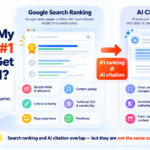
This isn’t a bug, and it isn’t bad luck. It’s because ranking #1 and getting cited by AI are two different systems, evaluating two different things.
The core idea: Google’s ranking algorithm asks “which page best matches this search?” An AI system asks a different question entirely — “which source can I safely lift a specific, verifiable answer from?” A page can win the first contest and lose the second one completely.
Two Systems, Two Different Jobs
| Traditional Search Ranking | AI Citation |
What it rewards | Keyword relevance, backlink authority, user engagement signals | Extractable, verifiable answers with clear structure |
Unit of evaluation | The whole page | A specific passage or fact within the page |
Trust signal | Domain authority, link profile | Entity consistency, third-party corroboration |
Content style that wins | Comprehensive, persuasive, SEO-optimized | Direct, fact-dense, unambiguous |
Technical requirement | Indexable by Googlebot | Parseable by AI crawlers — often a different bar entirely |
A page can be genuinely excellent by the first column’s standards and nearly invisible by the second’s.
A Real Example: Same Fact, Two Different Outcomes
Here’s what this actually looks like at the sentence level. Imagine a page ranking #1 for “how long does grout sealant take to dry.”
Before — ranks #1, never gets cited:
“Grout sealing is an important part of any tiling project, and homeowners often have questions about timing. There are several factors that can affect how quickly your sealant cures, including the type of product used, humidity levels, and ventilation. Generally speaking, most professionals recommend allowing adequate time before exposing the area to water.”
This reads well, ranks fine, and satisfies a human skimming for context. But there’s no extractable fact here — no AI system can lift a clean answer from it, because the actual number is never stated.
After — same page, now citable:
“Grout sealant typically takes 24 hours to dry to the touch and 48–72 hours to fully cure before contact with water, depending on humidity and product type. (Source: manufacturer specification sheet.)”
Same topic, same underlying expertise — but now there’s a specific, quotable, sourced fact sitting in the first sentence. That’s the difference between a page AI systems can safely lift from and one they’ll quietly skip.
What AI Systems Actually Look For Before They’ll Cite You
- A directly extractable answer. AI systems favor content where a clear, standalone answer sits near the top of a section — not buried inside three paragraphs of scene-setting before the actual point. If a human has to read the whole page to find your answer, so does the model, and it often just moves to the next source instead.
- Structured data that confirms what the page is about. Schema markup (Article, FAQPage, Product, Organization) doesn’t just help rich results in Google — it gives AI systems a machine-readable confirmation of what your content actually is, rather than making them infer it from prose alone.
- Entity consistency across the web. If your brand, your claims, and your expertise show up consistently across your own site, third-party citations, and structured data — the same name, the same facts, the same positioning everywhere — AI systems trust you as a stable entity. Inconsistent or contradictory information across sources actively works against citation.
- Third-party corroboration. AI systems weigh independent confirmation heavily. A claim that only exists on your own domain reads differently to a language model than the same claim echoed by a review site, a press mention, or an industry publication.
- Technical accessibility for AI crawlers. This is the one that catches the most people off guard — see below.
The Most Common Reasons a #1 Page Gets Skipped
Reason | Why It Blocks AI Citation |
Content loads via JavaScript without server-side rendering | Many AI crawlers see the empty shell of the page, not the actual content, even though Googlebot renders it fine |
No structured data at all | This is one reason AI SEO should address both content and the technical signals that help AI systems understand a page. |
The answer is technically present but buried | Marketing framing, long intros, and indirect language delay the actual fact past where extraction happens |
Claims aren’t backed by any external source | Self-reported facts with zero third-party echo are the easiest kind of content for an AI system to leave out |
The page is one of many near-duplicates | If ten pages on your site all say a slightly different version of the same thing, AI systems can’t tell which is authoritative — so none of them get cited confidently |
Content sits behind interaction | Text inside collapsed accordions, tabs, or “read more” toggles that isn’t in the initial page load is frequently invisible to AI crawlers, even when visible to human visitors |
What This Looks Like By Page Type
The fix isn’t identical for every kind of page. Here’s how the same principle applies differently depending on what you’re optimizing:
Page Type | Most Common Citability Gap | The Fix |
Blog / informational article | Answer buried after a long intro | Lead with the direct answer in the first 1–2 sentences under the heading |
Product page | Specs scattered across prose or hidden in images | Structured attributes (Product schema) with consistent, explicit values |
Local service page | Generic city-name-swapped content with no real local facts | Genuine local detail — service area, real examples, local contact path |
Comparison / “X vs Y” page | Vague, adjective-heavy comparisons (“great,” “better value”) | Explicit, factual criteria in a table format, not persuasive language |
FAQ page | Questions phrased differently than how people actually ask them | Match real search/voice phrasing, with FAQPage schema markup |
Quick Self-Audit: Is Your #1 Page Actually AI-Citable?
Before assuming this is unfixable, check the basics:
- View your page with JavaScript disabled. Is the core content still there? If not, that’s likely your biggest single blocker.
- Search Google for an exact sentence from your page. If it doesn’t appear at all, the page may not be indexed the way you think it is.
- Read just the first two sentences under your main heading. Do they actually answer the question, or do they set up the answer that comes three paragraphs later?
- Check whether your key claims appear anywhere else on the web. If a fact only exists on your own domain, it’s carrying less weight than you’d expect.
- Run the Google Rich Results Test on the page. No structured data at all is a very common, very fixable gap.
A “no” on any of these is a concrete, specific reason your ranking isn’t converting into citation — not a mystery.
How Long Does This Actually Take to Fix?
Realistically: technical accessibility issues (JavaScript rendering, structured data) can often be resolved in days, but AI citation itself tends to lag behind the fix by weeks to months, since it depends on AI systems re-crawling and re-evaluating the page, plus building the entity consistency and third-party corroboration that reinforce it. There’s no reliable way to force a citation on demand — but there is a reliable way to remove the specific, identifiable barriers standing between a strong ranking and an actual citation.
The same principle applies beyond AI search. Ranking prominently doesn’t always mean you’re achieving the business outcome you want, as seen in our guide to ranking in Google Maps but getting few leads
Frequently Asked Questions
Can a page rank #1 on Google but be completely invisible to AI search?
Yes. Google’s ranking algorithm and AI citation selection use different criteria. A page can satisfy traditional ranking factors while failing the specific technical and structural requirements AI systems use to select citable sources.
Does adding schema markup guarantee AI citation?
No. Structured data makes a page easier for AI systems to correctly interpret, but it doesn’t guarantee selection — content quality, entity consistency, and third-party corroboration all factor in as well.
Why does a lower-ranking competitor get cited by AI instead of me?
Citation often favors pages with a clearer, more directly extractable answer and stronger entity consistency across the web — not necessarily the page with the strongest traditional ranking signals.
Is this the same thing as Generative Engine Optimization (GEO)?
Yes — this is exactly what GEO addresses: optimizing a brand’s content, structure, and entity signals so generative AI systems are more likely to cite or recommend it, as a distinct discipline from traditional SEO.
Should I stop focusing on traditional rankings to chase AI citation instead?
No — the two reinforce each other over time (AI Overviews in particular draw heavily from strong organic rankings), but they require separate, deliberate work. Neither replaces the other.
- By Varun Kumar