
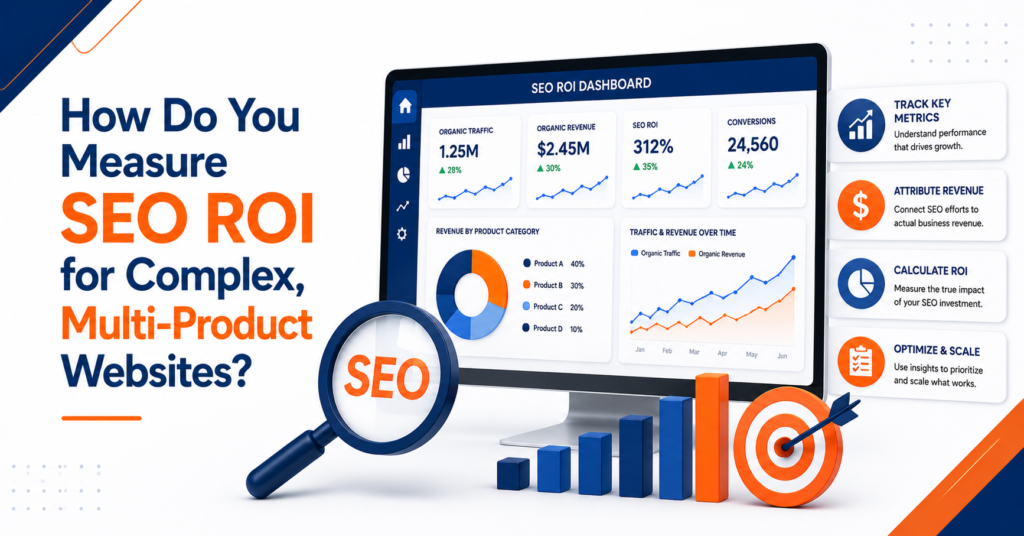
How Do You Measure SEO ROI for Complex, Multi-Product Websites?
Search engine optimization once felt simple. Rankings improved, traffic climbed, and success was celebrated. For large, multi-product websites in 2026, that simplicity no longer exists. Long sales cycles, many client journeys, thousands of URLs, and varying product values make standard SEO evaluation seem insufficient and occasionally even deceptive.
In 2026, measuring SEO ROI for intricate, multi-product websites will necessitate going beyond simple traffic analytics to sophisticated financial modeling. The emphasis switches to transferring value across thousands of product pages and various client journeys for large-scale websites. The tale is no longer told just by traffic. True efficiency is now defined by revenue responsibility, cost visibility, and intent-based evaluation.
Behind every organic visit is a decision, a comparison, or a future purchase waiting to happen. The challenge is learning how to measure that impact correctly.
Why Traditional SEO ROI Metrics Fall Short
Single-product websites can often rely on simple conversion tracking. A visitor arrives, buys, and the revenue is recorded. Multi-product platforms operate differently. One visitor might explore five categories, read multiple guides, leave, return weeks later, and finally convert through a branded search.
Last-click attribution hides this journey. Traffic numbers inflate confidence without explaining value. Rankings improve without proving profit. SEO ROI must reflect financial reality, not surface-level growth.
That shift begins by understanding the full investment behind SEO.
1. Calculate Comprehensive SEO Investment
Large websites often underestimate how much SEO truly costs. Agencies are only one piece of the equation. Accurate ROI starts with a complete view of every resource involved.
Direct Costs
Agency retainers, freelancer payments, editorial outsourcing, and dedicated link-building budgets all belong in the calculation. These costs are easy to track but rarely represent the full picture.
Internal Resources
In-house SEO specialists, developers handling technical fixes, and content managers coordinating production all contribute value. Pro-rated salaries must be included, even when SEO is not their sole responsibility.
Tech Stack
Sophisticated technologies are required for enterprise SEO. Platforms such as Semrush, Ahrefs, Botify, crawler software, log-file analysis programs, and data connectors are examples of ongoing expenditures. Software upgrades and custom integrations add another level of cost.
Overlooking these factors results in overstated ROI estimates that crumble when examined closely.
2. Isolate Organic Revenue by Product Segment
Total organic revenue sounds impressive but reveals very little. Complex websites generate value unevenly. Some product categories thrive while others quietly drain resources.
URL-Level Attribution
Grouping URLs by category, product type, brand versus non-brand, or informational versus transactional pages reveals where SEO actually works. This segmentation exposes which areas deserve expansion and which require correction.
E-commerce Integration
Google Analytics 4 (GA4), when integrated with platforms like Shopify or custom e-commerce setups, allows purchase events to be attributed directly to organic search. Revenue stops being theoretical and becomes measurable.
Lead Valuation for Sales-Driven Products
Not every product converts instantly. Some require demos, consultations, or nurturing. In these cases, leads must be assigned financial value.
The formula remains simple but powerful:
Lead Value = Customer Lifetime Value (CLV) × Conversion Rate
This approach respects long sales cycles while maintaining financial accuracy.
3. Use Advanced Attribution Models
Complex buyer journeys rarely follow straight lines. A blog post sparks interest. A category page builds trust. A product page closes the deal. Last-click attribution ignores everything except the finish line.
Multi-Touch Attribution
Combining first-click and last-click models reveals the complete journey. SEO often plays the discovery role, introducing users before paid channels or direct visits take over.
Assisted Conversions
GA4’s Assisted Conversions report uncovers how often organic search influenced a sale without being the final interaction. These insights protect SEO from being undervalued during budget discussions.
SEO’s true power often lives upstream, shaping decisions long before transactions occur.
4. Apply the SEO ROI Formula
Once organic revenue and total SEO costs are isolated for a defined period, preferably six to twelve months to account for SEO lag, the calculation becomes clear.
SEO ROI = [(SEO Revenue − SEO Cost) / SEO Cost] × 100
This formula delivers more than a percentage. It provides confidence. It transforms SEO from a cost center into a measurable investment with accountability.
Short-term measurements distort reality. SEO rewards patience, consistency, and compounding effort.
5. Alternative Valuation: Traffic Value (CPC)
Not every page drives immediate revenue. Brand content, comparison guides, and educational resources influence future decisions without producing instant conversions.
For these segments, Traffic Value Estimates offer clarity.
This method calculates how much would have been spent on PPC to acquire the same traffic for those keywords. The result represents cost savings rather than direct profit.
Traffic value acts as a secondary ROI indicator, especially for awareness-driven content that strengthens long-term brand equity.
Key Performance Benchmarks for 2026
Context matters. Without benchmarks, ROI numbers feel abstract.
Payback Period
E-commerce SEO typically reaches breakeven within nine to twelve months. Faster results often signal strong foundations or low competition.
Expected ROI Ratio
A healthy SEO ROI usually falls between 3:1 and 5:1 over three years. High-performing industries, especially those with strong brand trust and repeat purchases, sometimes achieve ratios as high as 22:1.
These benchmarks frame expectations and protect SEO from unrealistic demands.
The Emotional Truth Behind SEO ROI
SEO rarely delivers instant gratification. Progress happens quietly, page by page, crawl by crawl. Teams invest months refining structure, improving content, and fixing technical debt long before results surface.
Measuring SEO ROI correctly honors that effort. It gives visibility to invisible wins. It turns patience into proof. For complex, multi-product websites, SEO becomes less about rankings and more about sustained business growth.
When measurement evolves, strategy evolves with it.
SEO stops being guessed. It starts being trusted.
- By Varun Kumar