Why Does ChatGPT Recommend My Competitor Instead of Me?
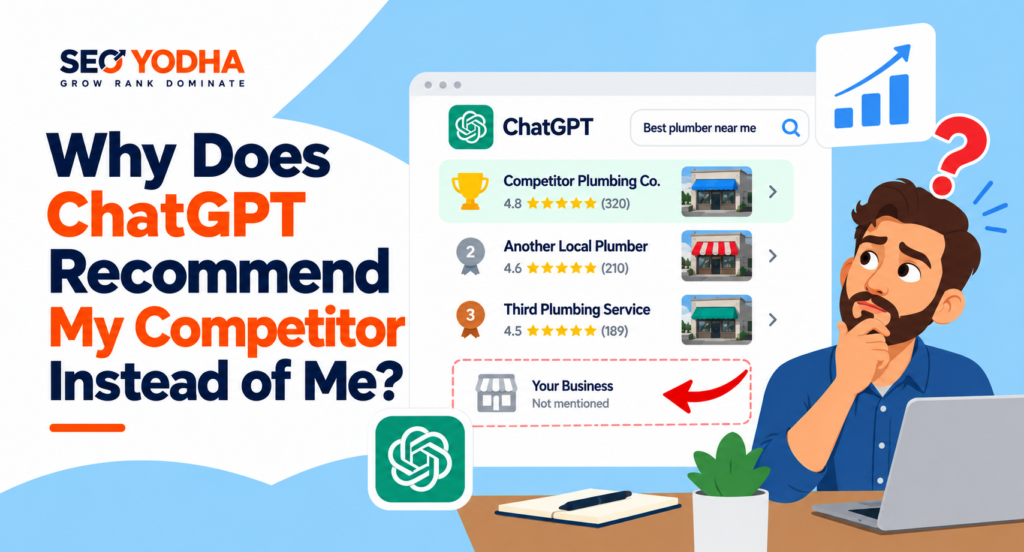
You tried it on a slow afternoon. You opened ChatGPT and typed the exact question your best customers ask before they call someone like you. The answer came back with three or four business names, neatly explained. Yours wasn’t one of them. Worse, one of those names belongs to a competitor you know you’ve been beating for years: better reviews, better work, maybe even a better Google ranking.
That moment stings, and it raises an uncomfortable question. If AI assistants are becoming the first place people go to decide who to hire, why is one of your rivals getting the introduction instead of you?
The short answer is that an AI assistant isn’t ranking websites the way Google does. It is deciding which brands it can talk about with confidence. Your competitor may simply be easier for an AI system to understand, describe, and trust, even if you are the stronger business in real life.
The core idea: Google asks which page best matches a search. An AI assistant asks something closer to: which businesses do I have enough consistent, corroborated information about to recommend without being wrong? Being the better business and being the better-documented business are two different things.
To improve your chances of being discovered and recommended by AI assistants, explore our AI SEO services to learn how businesses can strengthen their visibility across AI-powered search experiences.
What Is Actually Happening When ChatGPT “Recommends” a Business
It helps to demystify the process, because the mystery is what makes this feel personal. When someone asks an AI assistant for a recommendation, the response is built from a mix of two things: what the model absorbed about the world during training, and, in many cases, fresh information it retrieves from the web at the moment of the question.
In both cases, the assistant is looking for patterns. Which businesses keep appearing in connection with this topic? Which are described in similar terms by different sources? Which have a clear, specific identity attached to them? A business that shows up repeatedly, in consistent language, across independent places becomes easy to name. A business that appears only on its own website, described a little differently each time, is much harder for the system to feel sure about.
This is why the experience can feel unfair. Nobody at the AI company decided to favor your competitor. Their business simply left a clearer trail.
Want to understand why some pages get mentioned by AI while others don’t? Read our guide on Why Does My Site Rank #1 But Never Get Cited by AI? to learn how page-level citations differ from brand-level recommendations.
Google Ranking vs. AI Recommendation: Not the Same Contest
Most business owners carry over what they know about Google, and that is where the confusion starts. The two systems reward different things, which is why a business can dominate one and barely register in the other.
Comparison Factor | Google Search | AI Assistant Recommendation |
What is evaluated | Individual pages matched to a query | Whole brands and how confidently they can be described |
What the output looks like | A list of links to choose from | A short answer that names a few businesses |
Strongest influences | Relevance, links, engagement, technical health | Topical depth, independent mentions, consistent descriptions |
Cost of being missing | You sit lower on a page the user can scroll | You are often simply absent from the answer |
How much room at the top | Ten or more positions | Typically a handful of names |
That last row is the real source of the anxiety. A results page has room for everyone. An AI answer has room for three or four businesses, and the ones left out don’t get a second page to be found on.
The Real Reasons a Competitor Gets Named Instead of You
There is rarely one single cause. In practice it’s a combination of the factors below, and the encouraging part is that nearly all of them are things you can change.
1. They cover the topic more completely than you do
This is topical authority, and it is probably the biggest factor. A competitor who has published thorough, connected content on every question a buyer might ask, from pricing factors to common mistakes to how to choose, gives an AI system a rich, consistent picture of what they know. If your site has a services page and a handful of blog posts, you’ve given it a sketch. They’ve given it a map.
2. Other people talk about them, not just themselves
A claim made only on your own website is easy for an AI system to discount. The same claim echoed in a review site, a local news feature, an industry directory, a community discussion, or a roundup article is far more persuasive. Competitors who get named often have a wider footprint of independent mentions, even when their actual work is no better than yours.
3. Their identity is consistent everywhere
If your business is “Smith & Co” on your site, “Smith and Company LLC” on one directory, and “Smith Group” on another, with three different descriptions of what you do, an AI system can’t confidently treat them as one thing. A competitor with one name, one clear description, and matching details across the web is simply easier to recognize and repeat.
4. They are positioned for a specific kind of customer
Assistants answer specific questions. “Best accountant” is vague; “best accountant for freelancers with international clients” is not. A business that has clearly staked out who it serves, in plain words repeated across its content, gets matched to those specific questions. A business that describes itself as serving everyone tends to get matched to none of them.
5. They appear in the lists and comparisons AI systems lean on
When people ask for recommendations, assistants frequently draw from roundup articles, comparison pages, and “best of” lists. If your competitor is included in several of those and you aren’t in any, the gap in recommendations may trace directly back to that gap in inclusion.
6. Their reviews are richer and more recent
Volume matters less than substance here. Reviews that describe specific services, outcomes, and customer types give an assistant concrete language to work with. A long run of five-star ratings with no detail is far less useful than fewer reviews that actually say what the business did.
7. Their site is easier for AI systems to read
Content hidden behind scripts, buried inside images or PDFs, or collapsed into tabs that don’t load by default can be effectively invisible to some AI crawlers. Clean, text-based pages with sensible structure and structured data are simply easier to process, so they are processed more often.
Quick Diagnostic: What Is Your Competitor Doing That You Aren’t?
Signal | What to Look For on the Competitor | What to Check on Your Side |
Topical depth | How many distinct questions their site answers | Count the buyer questions your site answers well |
Independent mentions | Where their name appears outside their own site | Search your brand name plus relevant terms and compare |
Consistency | Same name and description across profiles | Audit every directory, social profile, and listing |
Positioning | Who they say they serve, in their own words | Read your homepage as a stranger: is it obvious who you are for? |
List inclusion | Roundups and comparison articles that include them | Find those same articles and note whether you appear |
Review substance | What their reviews actually describe | Read your last 20 reviews for specifics |
A Realistic Example
Picture two regional bookkeeping firms. Firm A has been around longer, has excellent client relationships, and ranks well on Google for its city name plus “bookkeeping.” Its website has a services page, a contact page, and four blog posts from a few years ago. Its name appears slightly differently in three directories.
Firm B is newer. Over eighteen months, it published detailed guides on topics like preparing for a tax audit, choosing between bookkeeping software, and what to expect in the first ninety days of working with a bookkeeper. It uses the same name and one-sentence description everywhere. It is included in two local business roundups and has a few detailed reviews that mention specific services.
When a prospective client asks an AI assistant for bookkeeping help for a small restaurant, Firm B is far more likely to be named. Not because it’s better at bookkeeping, but because it is far easier to describe confidently. This scenario is illustrative, but the pattern it shows is the one most owners discover when they run this test on themselves.
How to Test This Properly (Without Fooling Yourself)
A single query isn’t evidence. AI answers vary from session to session and from platform to platform, so a fair test needs a little discipline.
- Write a fixed set of 15 to 20 real customer questions. Use the language buyers actually use, including specific situations, not just generic category terms.
- Run each one across several assistants. ChatGPT, Gemini, Perplexity, Claude, and Google’s AI features can each behave differently.
- Repeat across sessions and days. Record whether you’re mentioned, who is mentioned instead, and what reasons are given.
- Look at the sources, where shown. If an assistant cites specific pages or sites, those are the places influencing the answer, and the places you may need to appear.
- Track the pattern, not the single result. You’re looking for trends over weeks, not one lucky or unlucky response.
A 90-Day Plan to Close the Gap
There is no switch to flip, and nobody can promise a particular recommendation. But there is a sensible order of operations, and it mirrors how topical authority is built in practice.
Phase | Focus | Concrete Actions |
Days 1–30: Foundation | Clarity and consistency | Standardize your business name and one-line description everywhere. Fix inconsistent listings. Rewrite your homepage so it states plainly who you serve and what you do. Make sure key content is real text, not hidden in images or scripts. |
Days 31–60: Depth | Topical coverage | Map the 20 to 30 questions your best customers ask. Publish thorough, direct-answer pages for the most valuable ones, each linked to the others and to your core service pages. Add structured data where appropriate. |
Days 61–90: Corroboration | Independent mentions | Pursue inclusion in relevant roundups and directories. Encourage detailed customer reviews. Contribute expertise to industry publications and community discussions where it is genuinely welcome. Re-run your prompt test and compare. |
Want to understand how visible your business is across AI-powered search? Request a free AI visibility audit to identify opportunities to improve your online presence.
What Not to Do
When the anxiety kicks in, shortcuts get tempting. A few are worth ruling out explicitly, because they tend to backfire.
- Don’t fake reviews or mentions. Platforms detect it, and it undermines the very trust signals you’re trying to build.
- Don’t hide instructions for AI systems in your pages. Invisible text aimed at manipulating assistants is a known bad practice and can get a site penalized.
- Don’t mass-produce thin content. Fifty shallow pages dilute your topical authority instead of building it.
- Don’t spam forums and communities. Self-promotion that ignores the community’s norms damages reputation, which is exactly what AI systems learn from.
- Don’t chase one prompt. Optimizing for a single phrasing is fragile. Build coverage of the topic and the phrasings take care of themselves.
Setting Realistic Expectations
Nobody controls what an AI assistant says. The models change, the retrieval methods change, and the answers shift from one session to the next. Anyone promising guaranteed placement in AI answers is overselling. What you can control is how clear, complete, consistent, and well-corroborated your business looks to the systems doing the reading.
The good news is that these are the same qualities that tend to help with traditional search and with real customers. A clearer homepage, a more complete body of content, consistent listings, and better reviews rarely hurt anyone. You’re not building something only for machines. You’re making your business easier to understand, for everyone, including the machines.
Frequently Asked Questions
Why does ChatGPT recommend my competitor and not my business?
AI assistants tend to name businesses they can describe confidently. A competitor may have more complete content on the topic, more independent mentions, more consistent information across the web, and clearer positioning, even if your actual service is as good or better.
Is ChatGPT’s recommendation the same as a Google ranking?
No. Google ranks individual pages in a list. An AI assistant usually names a small number of brands in a written answer, based on how well it can understand and corroborate them. Strong Google rankings help but do not guarantee being named.
How long does it take to start appearing in AI recommendations?
It varies. Fixing consistency and clarity can be done within weeks, but changes in AI answers usually lag behind, since they depend on systems re-reading your site and on independent mentions accumulating. Think in months, not days, and track trends rather than single responses.
Can I pay to be recommended by ChatGPT?
Not in the sense of buying a placement in its organic answers. What you can invest in is the underlying work: better content, stronger reputation, and consistent business information that makes you easier to recommend.
Do reviews really affect whether AI mentions my business?
They can contribute. Detailed reviews that describe specific services and outcomes give AI systems useful language and corroboration, whereas generic ratings with no detail offer little to work with.
Should I stop investing in traditional SEO and focus on AI?
No. The two reinforce each other. Strong organic content and authority support AI visibility, and AI-friendly clarity tends to help traditional search too. Treat them as complementary.
Where to Start
If you only do one thing this week, run the prompt test described above and write down who gets named instead of you, and why. That list is the most useful competitive research you can get, because it shows you exactly which signals the assistants are picking up on. From there, the 90-day plan is a roadmap, not a mystery.
Want a second set of eyes? SEO Yodha offers a free AI visibility review that shows where your business is and isn’t being named across the major AI platforms, and what is most likely holding it back.
- By Varun Kumar